

Fiber, also spelled fibre, is a class of materials that are continuous filaments or are in discrete elongated pieces, similar to lengths of thread.
They are very important in the biology of both plants and animals, for holding tissues together.
Human uses for fibers are diverse. They can be spun into filaments, string or rope, used as a component of composite materials, or matted into sheets to make products such as paper or felt. Fibers are often used in the manufacture of other materials. The strongest engineering materials are generally made as fibers, for example carbon fiber and Ultra-high-molecular-weight polyethylene.
Synthetic fibers can often be produced very cheaply and in large amounts compared to natural fibers, but for clothing natural fibers can give some benefits, such as comfort, over their man-made counterparts.
Textile Fibre
A unit in which many complicated textile structures are built up is said to be textile fiber.
Textile Fiber is the raw material required for the textile industry.
Naturel Fibres
Natural fibers include those produced by plants, animals, and geological processes. They are biodegradable over time. They can be classified according to their origin:
- Vegetable fibers are generally based on arrangements of cellulose, often with lignin: examples include cotton, hemp, jute, flax, ramie, and sisal. Plant fibers are employed in the manufacture of paper and textile (cloth), and dietary fiber is an important component of human nutrition.
- Wood fiber, distinguished from vegetable fiber, is from tree sources. Forms include groundwood, thermomechanical pulp (TMP) and bleached or unbleached kraft or sulfite pulps. Kraft and sulfite, also called sulphite, refer to the type of pulping process used to remove the lignin bonding the original wood structure, thus freeing the fibers for use in paper and engineered wood products such asfiberboard.
- Animal fibers consist largely of particular proteins. Instances are spider silk, sinew, catgut, wool and hair such as cashmere, mohair and angora, fur such as sheepskin, rabbit, mink, fox, beaver, etc.
Man-made Fibres
Synthetic or man-made fibers generally come from synthetic materials such as petrochemicals. But some types of synthetic fibers are manufactured from natural cellulose, including rayon, modal, and the more recently developed Lyocell. Cellulose-based fibers are of two types, regenerated or pure cellulose such as from the cupro-ammonium process and modified cellulose such as the cellulose acetates.
Fiber classification in reinforced plastics falls into two classes: (i) short fibers, also known as discontinuous fibers, with a general aspect ratio (defined as the ratio of fiber length to diameter) between 20 to 60, and (ii) long fibers, also known as continuous fibers, the general aspect ratio is between 200 to 500.
Cellulose fibers
- Cellulose fibers are a subset of man-made fibers, regenerated from natural cellulose. The cellulose comes from various sources. Modal is made from beech trees, bamboo fiber is a cellulose fiber made from bamboo, seacell is made from seaweed, etc.
Mineral fibers
Mineral fibers can be particular strong because they are formed with a low number of surface defects.
- Fiberglass, made from specific glass, and optical fiber, made from purified natural quartz, are also man-made fibers that come from natural raw materials, silica fiber, made from sodium silicate (water glass) and basalt fiber made from melted basalt.
- Metallic fibers can be drawn from ductile metals such as copper, gold or silver and extruded or deposited from more brittle ones, such as nickel, aluminum or iron.
- Carbon fibers are often based on oxydized and carbonised polymers, but the end product is almost pure carbon.
Polymer fibers
- Polymer fibers are a subset of man-made fibers, which are based on synthetic chemicals (often from petrochemical sources) rather than arising from natural materials by a purely physical process. These fibers are made from:
- polyamide nylon,
- PET or PBT polyester
- phenol-formaldehyde (PF)
- polyvinyl alcohol fiber (PVA)
- polyvinyl chloride fiber (PVC)
- polyolefins (PP and PE)
- acrylic polyesters, pure polyester PAN fibers are used to make carbon fiber by roasting them in a low oxygen environment. Traditional acrylic fiber is used more often as a synthetic replacement for wool. Carbon fibers and PF fibers are noted as two resin-based fibers that are not thermoplastic, most others can be melted.
- Aromatic polyamids (aramids) such as Twaron, Kevlar and Nomex thermally degrade at high temperatures and do not melt. These fibers have strong bonding between polymer chains
- polyethylene (PE), eventually with extremely long chains / HMPE (e.g. Dyneema or Spectra).
- Elastomers can even be used, e.g. spandex although urethane fibers are starting to replace spandex technology.
- Polyurethane fiber
- Coextruded fibers have two distinct polymers forming the fiber, usually as a core-sheath or side-by-side. Coated fibers exist such as nickel-coated to provide static elimination, silver-coated to provide anti-bacterial properties and aluminum-coated to provide RF deflection for radar chaff. Radar chaff is actually a spool of continuous glass tow that has been aluminum coated. An aircraft-mounted high speed cutter chops it up as it spews from a moving aircraft to confuse radar signals.
Microfibres
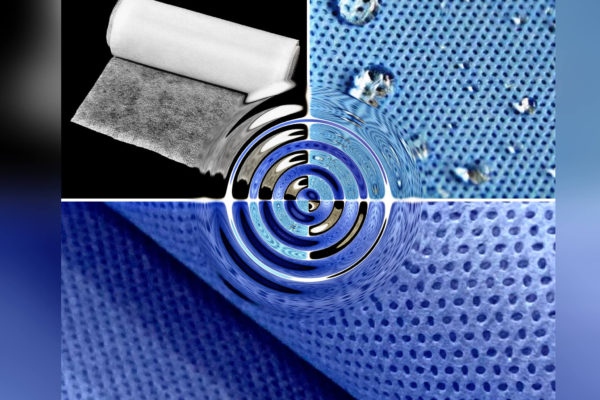
Microfibers in textiles refer to sub-denier fiber (such as polyester drawn to 0.5 dn). Denier and Detex are two measurements of fiber yield based on weight and length. If the fiber density is known you also have a fiber diameter, otherwise it is simpler to measure diameters in micrometers. Microfibers in technical fibers refer to ultra fine fibers (glass or meltblown thermoplastics) often used in filtration. Newer fiber designs include extruding fiber that splits into multiple finer fibers. Most synthetic fibers are round in cross-section, but special designs can be hollow, oval, star-shaped or trilobal. The latter design provides more optically reflective properties. Synthetic textile fibers are often crimped to provide bulk in a woven, non woven or knitted structure. Fiber surfaces can also be dull or bright. Dull surfaces reflect more light while bright tends to transmit light and make the fiber more transparent.
Very short and/or irregular fibers have been called fibrils. Natural cellulose, such as cotton or bleached kraft, show smaller fibrils jutting out and away from the main fiber structure.